
Chronic Obstructive Pulmonary Disease (COPD)
COPD remains heavily underdiagnosed in rural communities. The GOLD (Global Initiative for Chronic Obstructive Lung Disease) guidelines explicitly mandate spirometry to establish a clinical diagnosis of COPD.
Who Needs Baseline Testing?
- Any patient > 40 years old with a smoking history (> 10 pack-years).
- Patients presenting with chronic progressive dyspnea, chronic cough, or chronic sputum production.
- Patients with significant occupational exposure to agricultural dusts or chemical fumes.
When to Retest (Cadence)
- Annually: To track the rate of FEV1 decline (> 40 mL/year indicates rapid decline).
- Following any major acute exacerbation requiring hospitalization or systemic corticosteroids.
Adult Asthma Management
Asthma symptoms are highly variable. Relying solely on patient-reported symptoms often leads to under-treatment of silent airway inflammation or over-treatment of non-asthmatic coughs. Pre/Post-bronchodilator spirometry objectively measures airway reversibility.
Who Needs Baseline Testing?
- Patients presenting with episodic wheezing, chest tightness, or nighttime awakening.
- Patients requiring frequent refills of short-acting beta-agonists (Albuterol) without a confirmed objective diagnosis.
When to Retest (Cadence)
- Baseline: Initial diagnosis to document reversibility (> 12% and 200mL increase in FEV1).
- 3-6 Months: After initiating or stepping up ICS/LABA controller therapy to assess efficacy.
- Every 1-2 Years: To assess for progressive loss of lung function over time (airway remodeling).
Inhaled Medication Optimization (MDI vs. SVN)
Up to 90% of patients use their inhalers incorrectly, leading to frequent exacerbations and unnecessary escalations to expensive Small Volume Nebulizers (SVNs). During the mandatory 15-minute bronchodilator wait-period of our PFT suite, DirectCare executes formal Inhaler Technique Education (CPT 94664) to correct technique and guide evidence-based device selection.
The "Nebulizer Myth"
Many patients and providers incorrectly assume nebulizers provide a "stronger" treatment. Clinical evidence overwhelmingly demonstrates that a Metered Dose Inhaler (MDI) used with a Valved Holding Chamber (Spacer) is equally or more effective than a nebulizer.
- Faster Delivery: 4 puffs via spacer takes 1 minute; SVNs take 10-15 minutes.
- Fewer Side Effects: Spacers significantly reduce oral/pharyngeal deposition and systemic absorption compared to SVNs.
- Lower Cost: Nebulizers require electricity, maintenance, and vastly more expensive drug solutions.
Evidence-Based Device Succession
- 1. MDI + Valved Holding Chamber (Spacer): The absolute gold standard for the majority of COPD/Asthma patients. Eliminates the need for breath coordination.
- 2. Dry Powder Inhalers (DPI): Effective, but requires the patient to generate a sufficient inspiratory flow rate (often difficult for severe COPD or elderly patients).
- 3. Nebulizers (SVN): Should be strictly reserved for patients who are physically, cognitively, or mechanically unable to use an MDI with a spacer.
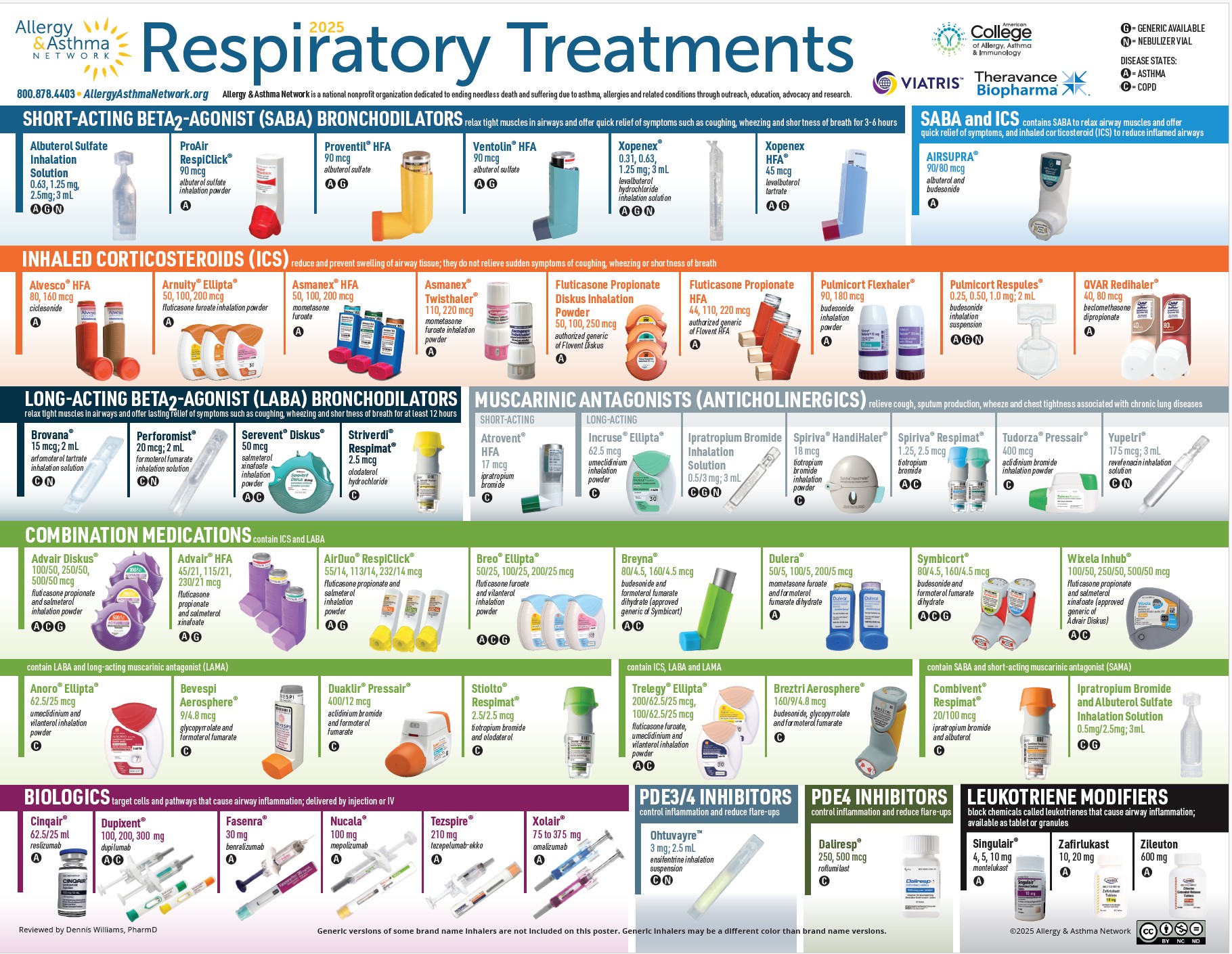
Reference Guide: Respiratory Treatments (2025)
A visual guide to the current landscape of inhalers, biologics, and nebulizer solutions to aid in evidence-based device selection.
Cardiology & Amiodarone Toxicity
Amiodarone is a highly effective antiarrhythmic, but carries a well-documented risk of amiodarone-induced pulmonary toxicity (APT). Interstitial lung damage can progress silently. Single-breath DLCO testing is critical for detecting early alveolar-capillary impairment before symptoms become severe.
Who Needs Baseline Testing?
- Mandatory: Any patient prior to the initiation of long-term Amiodarone therapy to establish baseline diffusion capacity.
When to Retest (Cadence)
- Annually: Routine monitoring for asymptomatic patients on long-term therapy.
- Immediately: If a patient develops new, unexplained dyspnea, non-productive cough, or hypoxemia. A decrease in DLCO ≥ 20% from baseline is highly suggestive of toxicity.
Pre-Operative Risk Stratification
Postoperative pulmonary complications (PPCs) are a leading cause of surgical morbidity and prolonged hospital stays. Identifying patients with undiagnosed airflow obstruction prior to general anesthesia is critical for surgical planning.
Who Needs Baseline Testing?
- Patients scheduled for lung resection, upper abdominal, or bariatric surgery.
- Patients with unexplained dyspnea, chronic cough, or exercise intolerance undergoing prolonged general anesthesia.
- Patients with known COPD or Asthma whose symptoms have worsened or remain un-optimized prior to surgery.
Diagnostic Value
- Allows the anesthesia team to optimize bronchodilator therapy prior to intubation.
- Predicts the risk of prolonged mechanical ventilation and the ability to successfully extubate post-procedure.